English


 |
1. History and Development
The Faculty of Finance – Banking and Insurance originated from the Economics Division of Nam Dinh Light Industrial Technical School, established in 1986. After several stages of upgrading and renaming, the Faculty of Finance – Banking and Insurance was officially established under the University of Economics – Technology for Industries (UNETI) according to Decision No. 274/QĐ-ĐHKTKTCN dated May 14, 2012.
The Faculty was established with the mission of training high-quality human resources to meet societal demands. The academic staff has continuously been strengthened and enhanced in professional capacity, with 100% of lecturers holding postgraduate degrees (Master’s level or higher).
The Faculty of Finance – Banking and Insurance has increasingly become a reputable and trusted academic unit, attracting significant attention from society and consistently being one of the top choices of applicants when registering for admission to the University. The Faculty has successfully completed the external quality accreditation of the Finance and Banking undergraduate training program in accordance with the standards set by the Ministry of Education and Training, achieving positive results.
With the accreditation certificate, the Faculty affirms to past, current, and future generations of students that its bachelor’s program is fully recognized by society as meeting professional standards. It contributes high-quality human resources to the national economy, ensuring that graduates have comprehensive development opportunities and the ability to stand out in a dynamic and highly competitive working environment.
2. Achievements
The Faculty collective has consistently demonstrated creativity, resilience, and excellence in fulfilling assigned tasks. Administrative and professional activities are well-organized, innovative, and effective.
In teaching activities:
The Faculty of Finance – Banking and Insurance consistently fulfills and excels in teaching responsibilities, actively encouraging lecturers to exchange experiences and improve teaching quality.
In training programs:
After many years of dedicated effort, all training programs, detailed course syllabi, and examination question banks have been fully developed and standardized.
-
Innovating objectives and adjusting curricula, training plans, and content in alignment with national framework programs and articulation between training levels;
-
Regularly updating content to incorporate advances in science, technology, and new equipment, and continuously improving teaching methodologies.
In scientific research:
-
Faculty members have participated in numerous institutional-level research projects and published articles in national and international conference proceedings and reputable academic journals;
-
Completed many textbooks, lecture materials, and high-quality multiple-choice examination banks for undergraduate programs.
Awards and Honors:
-
Excellent Labor Collective: 2012, 2013, 2015, 2017, 2018, 2019
-
Certificate of Merit from the People’s Committee of Nam Dinh Province: 2013
-
Certificate of Merit from the Minister of Industry and Trade: 2018
3. Organizational Structure
Faculty Executive Board:
-
Dean: PhD. Phung Thi Lan Huong
Email: plhuong@en.uneti.edu.vn -
Vice Dean: PhD. Vu Thi Thuc Oanh
Email: vttoanh@en.uneti.edu.vn
Party Cell of Finance – Banking and Insurance:
-
Party Secretary: PhD. Phung Thi Lan Huong
Departments under the Faculty:
-
Department of Corporate Finance
-
Department of Banking
4. Functions and Duties
Functions:
The Faculty of Finance – Banking and Insurance is an academic unit under the University, responsible for advising and assisting the Rector in implementing professional tasks, including: managing academic affairs in Finance and Banking programs; managing scientific and technological activities; developing curricula; compiling textbooks and teaching materials; and managing faculty members in fulfilling assigned teaching duties.
Duties:
-
Managing and developing the academic staff of Finance and Banking programs; developing training programs and enhancing quality assurance conditions to meet societal needs and international integration;
-
Organizing innovation in curriculum content and teaching methodologies to improve training quality; conducting professional activities and thematic scientific seminars; implementing experimental activities, scientific research projects, and applying technology in teaching;
-
Organizing and implementing scientific research and technological activities for faculty members and students;
-
Managing and effectively utilizing facilities and equipment assigned by the University; proposing plans for procurement, maintenance, and upgrading of teaching, practice, and internship facilities for Finance and Banking programs;
-
Coordinating with functional departments to collect employment data of graduates to support the Rector in formulating enrollment and training policies; strengthening cooperation between enterprises and the University in curriculum development, internships, and graduate employment support.
5. Training Specializations
|
Specialization |
Knowledge and Skills Acquired |
Career Opportunities and Job Positions after Graduation |
|
Corporate Finance |
|
|
|
Banking |
|
|
|
International Finance |
|
Potential career positions:
|
6. Professional Capacity
The faculty members of the Faculty of Finance and Banking possess strong professional expertise, with 100% of lecturers holding a Master’s degree or higher; they have extensive teaching experience, strong professional dedication, actively pursue further professional development, demonstrate solidarity, mutual support, and grow together.
In terms of training activities:
The Faculty of Finance and Banking continuously develops and improves its training programs to meet social demands and align with international integration trends. In particular, following the University’s overall orientation to strengthen practical skills training for students, the Faculty has developed practice-oriented Finance and Banking modules closely linked to real-world practice and has introduced five virtual Finance and Banking practice laboratories into teaching. With a high proportion of practical training, diverse practice content closely connected to reality, and role-playing as tax officers, transaction officers, investors in stock exchanges, enterprises, and banks, graduates of the Faculty of Finance and Banking are highly evaluated by employers as having solid professional knowledge and strong practical skills.
In terms of scientific research:
Each year, the Faculty presides over and participates in an average of 10 grassroots-level scientific research projects; publishes more than 100 articles in reputable specialized scientific journals; organizes numerous grassroots-level scientific conferences and participates in national and international conferences, with proceedings published. The research outcomes of faculty members have high applicability in practice.
In terms of training cooperation:
To develop training programs closely linked to practice and to create a practical learning environment for students, the Faculty of Finance and Banking always focuses on building a network of enterprises to jointly participate and collaborate in the training process. This is one of the important factors contributing to high training quality, ensuring that graduates meet societal requirements.
7. Development Orientation
Building on its established traditions, the Faculty of Finance and Banking continues to maintain its position as one of the key training units of the University of Economics – Technology for Industries, providing society with high-quality training, scientific research, consultancy, application, and technology transfer products, and making an important contribution to the overall development of the University, with the following objectives:
-
Striving to become one of the leading practical training institutions in Vietnam in the field of Finance and Banking;
-
Expanding cooperation in training and scientific research with domestic and international educational institutions; promoting lecturer exchanges with universities worldwide;
-
Strengthening cooperation with enterprises to create employment and practical internship opportunities for students;
-
Developing and expanding undergraduate and master’s degree programs in Finance and Banking with an application-oriented approach, joint training programs with foreign universities, and advanced high-quality programs.
8. Contact Information
-
Nam Dinh Campus: No. 353 Tran Hung Dao Street, Nam Dinh City.
-
Hanoi Campus: No. 456 Minh Khai Street, Hai Ba Trung District, Hanoi.
Email: khoatcnh@en.uneti.edu.vn
Website: http://khoatcnh.en.uneti.edu.vn/
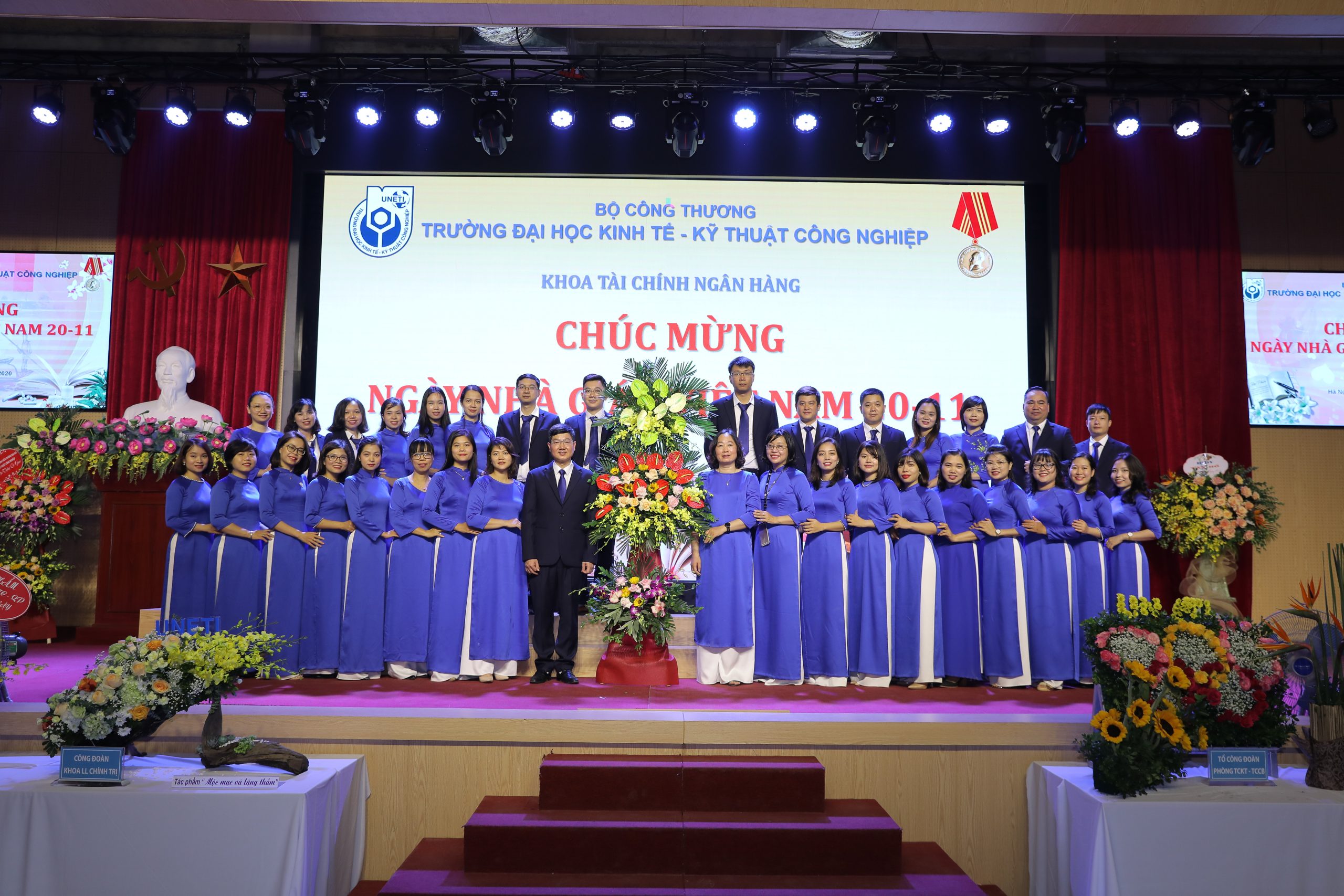
Photos of activities of the Faculty of Finance and Banking