

 English


 |
1. General information
-
Vietnamese name: Faculty of Commerce
-
English name: Faculty of Commerce
-
Training discipline: Commercial Business
Specializations:
-
Commercial Business
-
E-commerce
-
Logistics and Supply Chain Management
-
Training level: Bachelor
-
Type of training: Full-time
2. History of establishment and development
The Faculty of Commerce originated from the Economics Division of the Light Industry Technical School, which was established in 1986. After several stages of upgrading and renaming, the Faculty of Commerce was officially established under Decision No. 348/QĐ-ĐHKTKTCN dated May 31, 2022, of the University of Economics – Technology for Industries.
3. Organizational structure
-
Faculty leadership:
Dean: Dr. Nguyen Thi Chi
Email: ntchi@en.uneti.edu.vn
-
Party Cell Secretary: Comrade Dr. Nguyen Thi Chi
-
Trade Union Group: M.A. Tran Tho Khai
-
Faculty Youth Union Sub-committee:
Secretary: M.A. Tran Ngoc Tu
Deputy Secretary: M.A. Nguyen Van Hung
4. Functions and duties:
Functions:
The Faculty of Commerce is a unit under the University with the function of advising and assisting the Rector in organizing and implementing the following tasks: professional management of training in the Commercial Business discipline; management of scientific and technological activities; development of contents and curricula; compilation of textbooks and materials serving teaching and learning activities; management of lecturers in the performance of assigned teaching duties in the Commercial Business discipline.
Duties:
-
To manage and develop a teaching staff with deep expertise in the specializations of Commercial Business, E-commerce, and Logistics and Supply Chain Management; to develop training programs and enhance quality assurance conditions to meet social needs and international integration;
-
To develop contents and curricula for the specializations of Commercial Business, E-commerce, and Logistics and Supply Chain Management; to organize the implementation and management of the training process in these specializations in accordance with the general plan of the University;
-
To organize the implementation of scientific research tasks and scientific and technological activities for staff, lecturers, and students of the Faculty of Commerce; to proactively exploit cooperative training projects; to coordinate with scientific and technological organizations and production and business establishments in order to link training with scientific research, production and business activities, and social life;
-
To organize the compilation of textbooks and teaching materials for the specializations of Commercial Business, E-commerce, and Logistics and Supply Chain Management; to continuously research and improve teaching and learning methods in order to enhance training quality;
-
To manage and effectively utilize facilities and equipment assigned by the University; to propose plans for supplementation, procurement, and maintenance of equipment serving teaching, learning, practice, and internships in the specializations of Commercial Business, E-commerce, and Logistics and Supply Chain Management;
-
To coordinate with functional departments in collecting information on graduates’ employment in order to advise and assist the Rector in formulating enrollment and training policies; to coordinate with internal and external units in organizing scientific seminars, professional activities, establishing specialized clubs, and arranging internships, field visits, and practical experiences for students with the aim of linking teaching with practice and creating opportunities for learners to expand their knowledge both academically and socially;
5. Professional capacity
The full-time teaching staff of the Faculty of Commerce possesses strong professional expertise, with 100% of lecturers holding Doctoral or Master’s degrees; they have teaching experience, dedication to the profession, actively participate in professional development, maintain solidarity and mutual support, and grow together. In addition, the Faculty has a team of visiting lecturers who are Associate Professors, PhDs, and scientists with in-depth expertise in Commercial Business, E-commerce, and Logistics and Supply Chain Management.
-
Training activities:
The training program in Commercial Business is designed to ensure that learners are provided with information and knowledge, trained in analytical thinking methods, professional operational skills, and soft skills through interdisciplinary and specialized courses in Commercial Business, E-commerce, and Logistics and Supply Chain Management. Students of the Faculty of Commerce have access to modern training programs that closely integrate theory and practice; they are equipped with specialized skills taught entirely by experts, enabling them to confidently undertake professional work immediately after graduation; they are also encouraged to develop soft skills and personal strengths, adapt quickly, and integrate into diverse working environments. 100% of students are introduced by the Faculty to apprenticeship placements, final internships, and employment opportunities after graduation. Many graduates have found positions aligned with their training specializations and demonstrate high potential for career advancement. -
Scientific research activities:
With the principle that training must be closely linked with scientific research, scientific research activities are always carried out effectively with the aim of exploring, discovering, identifying, and updating new knowledge. Each year, the Faculty leads and participates in many scientific research projects at various levels and supervises student research; publishes articles in reputable domestic and international specialized scientific journals; and organizes many faculty-level scientific seminars while participating in national-level conferences. Research outcomes of lecturers have high applicability in practice. -
Training cooperation:
The Faculty of Commerce has established and continues to develop numerous cooperative relationships with training institutions, enterprises, and organizations both domestically and internationally in order to enhance training quality, serving as a bridge for students to exchange knowledge, undertake internships, and develop practical skills to meet employers’ requirements.
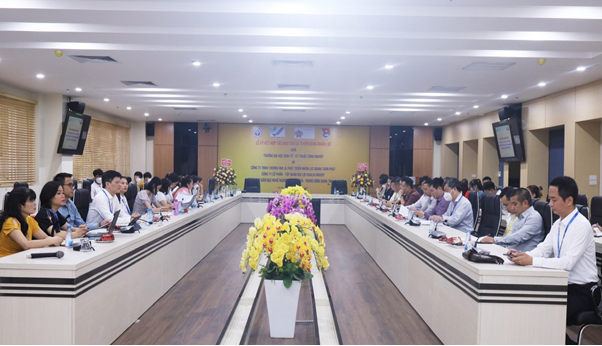
Signing ceremony of cooperation in training and human resource recruitment
– In the academic year 2021–2022, the Commercial Business training program completed the accreditation assessment and is currently awaiting the issuance of the certificate of recognition as meeting educational quality standards in accordance with the regulations of the Ministry of Education and Training.
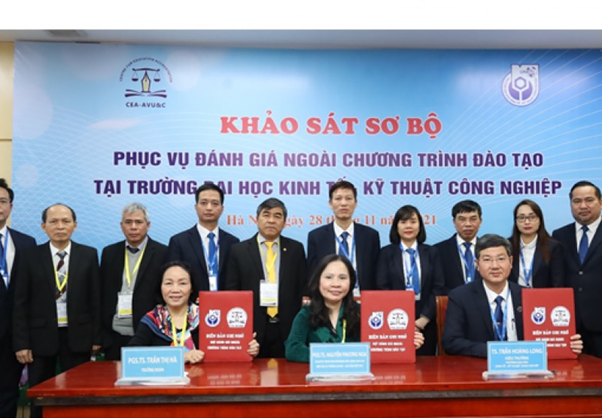
Quality accreditation of the Commercial Business training program
6. Development orientation
In the period of integration, facing great opportunities as well as many difficulties and challenges, the collective of lecturers of the Faculty of Commerce will continue to promote the traditions that have been achieved, make efforts in study and scientific research, cultivate ethical qualities and professional conduct of educators, and be determined to build the Faculty of Commerce into a strong collective with high professional competence and firm political integrity, making an important contribution to the overall development of the University of Economics – Technology for Industries, towards the following objectives:
-
Striving to become a leading practice-oriented training institution in Vietnam in the fields of Commercial Business, E-commerce, Logistics and Supply Chain Management;
-
Expanding cooperation in training and scientific research with domestic and international training institutions; exchanging lecturers with universities around the world;
-
Strengthening cooperation with enterprises to create employment opportunities and professional internships for students;
-
Developing and expanding undergraduate and master’s training programs in Commercial Business with an application-oriented approach, joint training programs with foreign universities, and advanced high-quality programs.
7. Contact
-
Nam Dinh campus: No. 353 Tran Hung Dao Street, Nam Dinh City.
-
Hanoi campus: Room 307 – HA11, No. 218 Linh Nam Street, Hoang Mai District, Hanoi.
Email: khoatm@en.uneti.edu.vn
Website: http://khoatm.en.uneti.edu.vn