

 English


 |
1. History and Development

-
Participated in the Ministry of Industry and Trade Skills Competition and won a Consolation Prize in 2012 and Third Prize in 2014.
-
Won Third Prize at the Robocon Techshow with a humanoid robot product in 2013.
-
Participated in the Honda Eco Mileage Challenge in 2014.
-
Achieved numerous outstanding accomplishments in faculty scientific research and student scientific research movements.
3. Organizational Structure:
Unit Leadership:
|
No. |
Name |
Position |
|
Tel |
|
1 |
TS Bùi Huy Hải |
Party Cell Secretary, Dean |
|
|
|
2 |
Th.S Châu Thanh Phương |
Vice Dean |
|
Subordinate Departments:
Department of Telecommunications Engineering
Head of Department: Dr. Nguyen Thi Hong Nhung
Deputy Head of Department: M.Sc. Dang Thi Huong Giang
Department of Electronic Engineering
Head of Department: Dr. Bui Huy Hai
Deputy Head of Department: M.Sc. Nguyen Mai Anh
Trade Union Group:
Head of Trade Union (Hanoi Campus): M.Sc. Nguyen Mai Anh
Head of Trade Union (Nam Dinh Campus): M.Sc. Tran Thi Huong
Faculty Youth Union of Electronics:
Secretary of the Faculty Youth Union: M.Sc. Tran Thu Huong
Deputy Secretary of the Faculty Youth Union: M.Sc. Vu Anh Nam
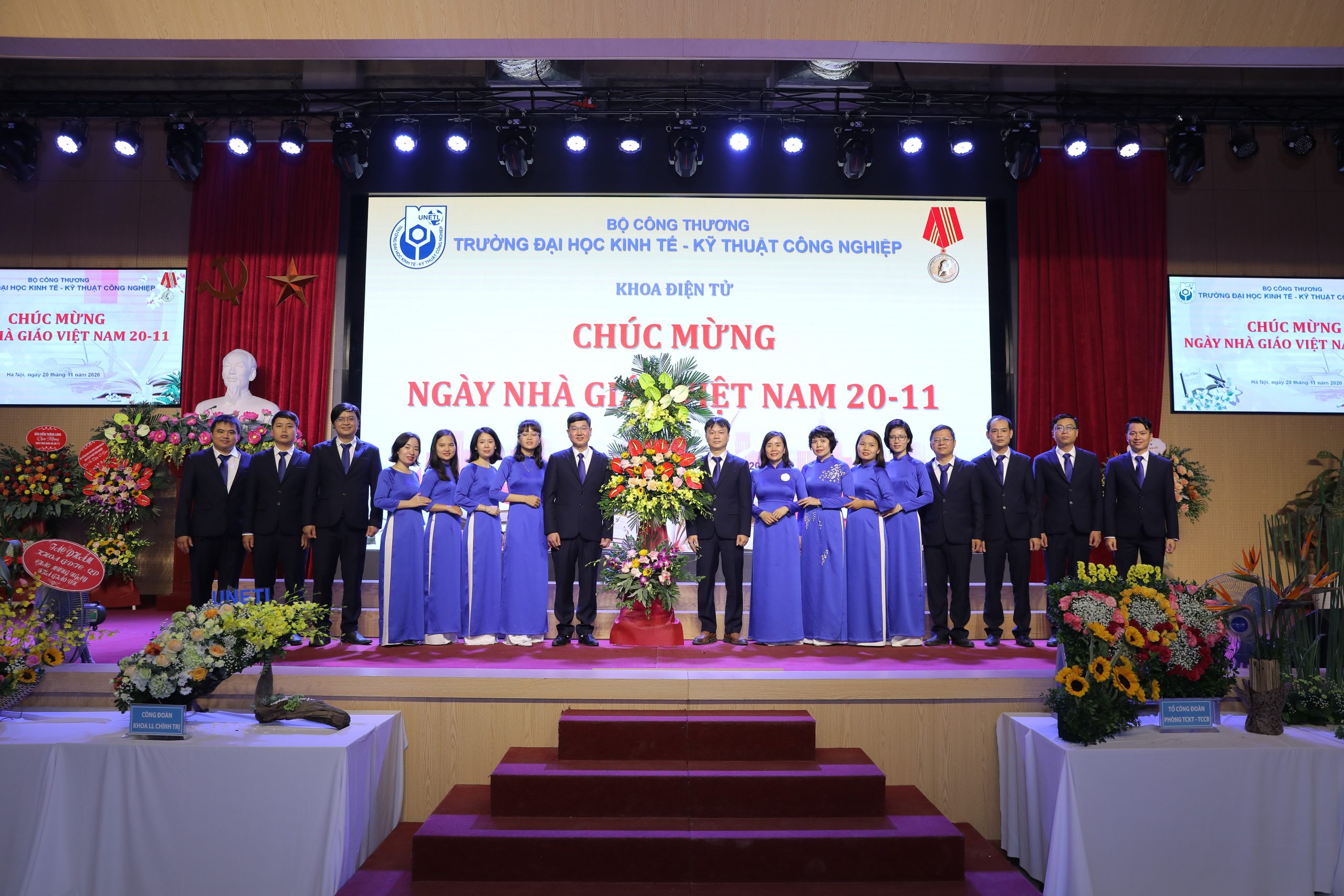
4. Functions and Responsibilities
-
Functions:
The Faculty of Electronics is a unit directly under the University, functioning as an advisory and assisting body to the Rector in organizing and implementing the following tasks: professional management of training programs in Electronics and Telecommunications Engineering and Computer Engineering; management of science and technology activities; development of curricula and programs; compilation of textbooks and teaching–learning materials; and management of lecturers in performing assigned teaching duties of the respective disciplines. -
Responsibilities:
Managing and developing the teaching staff; developing training programs; improving quality assurance conditions to meet societal needs and international integration;
Developing curricula and teaching contents for Electronics and Telecommunications Engineering and Computer Engineering; organizing, implementing, and managing the training process of the assigned programs in accordance with the University’s overall plans;
Organizing and implementing scientific research tasks and science and technology activities for faculty members and students of the Faculty of Electronics; proactively exploiting cooperative training projects (if any); coordinating with science and technology organizations as well as production and business entities to link training with scientific research, production, business activities, and social life;
Organizing the compilation of textbooks and teaching materials for the assigned disciplines; continuously researching and improving teaching and learning methods to enhance training quality;
Managing and effectively utilizing facilities and equipment assigned by the University; proposing plans for supplementation, procurement, and maintenance of equipment serving teaching, learning, practice, and internships in Electronics Engineering Technology and Computer Engineering Technology;
Coordinating with functional departments to collect information on employment outcomes of graduates in Electronics Engineering Technology and Computer Engineering Technology in order to advise and assist the Rector in formulating enrollment and training policies;
Coordinating with enterprises and internal and external units in training activities, scientific conferences, and professional exchanges;
Managing and orienting the activities of specialized clubs; organizing internships, field trips, and practical experience activities for students in order to link teaching with practice, creating opportunities for learners to broaden their knowledge both academically and socially.
5. Professional Capacity
Electronics and Telecommunications Engineering Technology
Currently, the Electronics and Telecommunications Engineering Technology program equips students with a wide range of practical knowledge applicable to various occupations in social life. Depending on specific fields, graduates may undertake different roles. According to current trends, the Electronics and Telecommunications Engineering Technology field has applications in many areas, including:
-
Research and development of new technologies and electronic and telecommunications devices
-
Networking and telecommunications
-
Positioning and navigation systems
-
Biomedical electronics
-
Recognition systems and automatic control

Computer Engineering Technology Program
The Computer Engineering Technology program integrates specialized knowledge from both electronic hardware and software design fields. Accordingly, the training content covers areas such as digital circuit design, microprocessors, and device control programming. With characteristics aligned to Industry 4.0 and preparation for integration into Society 5.0, this field places a stronger emphasis on artificial intelligence. Students of the Computer Engineering Technology program are equipped with the following core knowledge areas:
-
Embedded Programming: Developing software for device control and system programming (Assembly, drivers, firmware, C++, Python, Java, etc.); developing application software on devices; with particular emphasis on AI-integrated embedded systems.
-
Hardware System Design: Designing digital integrated circuits and hardware modules for electronic devices, computer-controlled systems, and robots.
-
Network System Design and Deployment: Designing and consulting on network application deployment; network system administration; consulting and supporting system security solutions.
-
Mobile Application Development: Using programming languages to develop and deploy applications that maximize usability and functionality for mobile devices on the two most widely used operating systems today, iOS and Android.
In addition, students are provided with practical, real-world experiences to effectively apply their knowledge and thereby foster creativity in their professional activities.


Career Orientation
Electronics and Telecommunications Engineering Technology
In today’s era of information explosion, electronic and telecommunications devices and systems form the core components of infrastructure systems, and almost everyone uses devices or systems provided by the Electronics–Telecommunications sector. Therefore, Electronics–Telecommunications engineers can work in companies involved in manufacturing, research, and development of electronic products; Internet service providers; data transmission and telecommunications companies; mobile network operators; broadcasting and wireless communication companies; television, cable TV, satellite television companies; as well as consulting firms and businesses providing electronic–telecommunications solutions and services, etc.
According to assessments by strategic planners, Electronics–Telecommunications is currently one of the fastest-growing sectors. The growth of the telecommunications industry has placed Vietnam among the top 10 countries worldwide in ICT (Information and Communication Technology) development.
At present, new networks such as Vietnamobile, EVN Telecom, and Viettel are expanding into markets such as Laos, creating strong demand for engineers in this field. Manufacturing plants of major corporations such as Samsung, LG (Korea), Intel, Microsoft (USA), Panasonic, Canon, Renesas (Japan), etc., when entering operational phases, require a large workforce in the fields of Computer Engineering and Electronics.
According to general labor and employment surveys in the Electronics–Telecommunications sector, the highest proportion of graduates work at international corporations and groups (Samsung, LG, Canon, Microsoft, Intel, Renesas, LSI, SDS, Shinko, etc.), followed by employment in state-owned enterprises (VNPT, Viettel, Mobifone, Vinaphone, VTV, VTC, etc.). These two sectors account for the largest employment share. In addition, graduates may also become researchers or lecturers at universities, colleges, vocational schools, and high schools.
Computer Engineering Technology
According to the “Strategy for the Development of Electronics–Information Technology of Vietnam to 2010 with Vision to 2020” approved by the Prime Minister, Computer Engineering is one of the most important tools for accelerating the process of industrialization and modernization of the country.
Currently, major corporations have begun investing in the development of embedded systems in Vietnam, including Intel, IBM, Altera, eSilicon, as well as companies from Japan and South Korea. The world is rapidly transitioning toward increasingly intelligent and compact devices such as smart cars, smartphones, smart clothing, smart keys, etc. Control systems are gradually shifting toward intelligent control systems in both industrial production and daily life. Therefore, in the near future, demand for human resources in Computer Engineering is expected to grow significantly.
After graduation, engineers majoring in Computer Engineering Technology from the University of Economics – Technology for Industries may undertake jobs requiring knowledge and skills in embedded programming and artificial intelligence; system hardware design; control system design; deployment of network systems in enterprises; implementation of safety and security systems; or pursue careers in research and teaching at relevant research and educational institutions.
7. Contact Information
Faculty of Electronics
-
Hanoi Campus: Room 802 – HA10 Building, 218 Linh Nam, Hoang Mai District, Hanoi.
-
Nam Dinh Campus: 4th Floor – NA2 Building, 353 Tran Hung Dao Street, Nam Dinh City.
-
Email: khoadientu@en.uneti.edu.vn