English


 |
1. History and Development
The Faculty of Textile and Fashion takes pride in being one of the faculties whose development has been closely associated with the establishment and growth of the University. In the early days, when the institution was known as Technical Secondary School No. III (the predecessor of the University of Economics – Technology for Industries), the Faculty trained the first cohorts of technicians in three majors: Textile, Yarn, and Dyeing. The first cohort consisted of 74 students, supplying human resources to the then nascent textile and yarn industry of the country.
During that initial period, both lecturers and students faced numerous challenges. Practical training equipment was severely limited; teaching materials, textbooks, and curricula were entirely dependent on resources from China. However, the Faculty’s lecturers demonstrated remarkable dedication by simultaneously teaching, learning, and drawing practical experience. They actively sought additional reference materials, developed lecture notes and textbooks, improved training programs, and gradually built academic autonomy before the Chinese experts returned to their home country.
Many students trained during this period later matured into highly capable professionals, holding senior positions in society as well as in various enterprises. At present, the Faculty offers training in two majors: Textile and Garment Technology (with specializations in Garment Technology and Fashion Design) and Textile and Garment Material Technology.
With its long-standing tradition as one of the first specialized faculties of the University of Economics – Technology for Industries, the Faculty of Textile and Fashion has continuously strived for excellence in all aspects. It has consistently affirmed its leading position in training quality, not only within the University but also in the textile and garment technology sector nationwide. The Faculty has made a strong impression through achievements in competitions at ministerial, national, continental, and international levels, while steadily supplying high-quality human resources to organizations and enterprises across the country.
2. Achievements
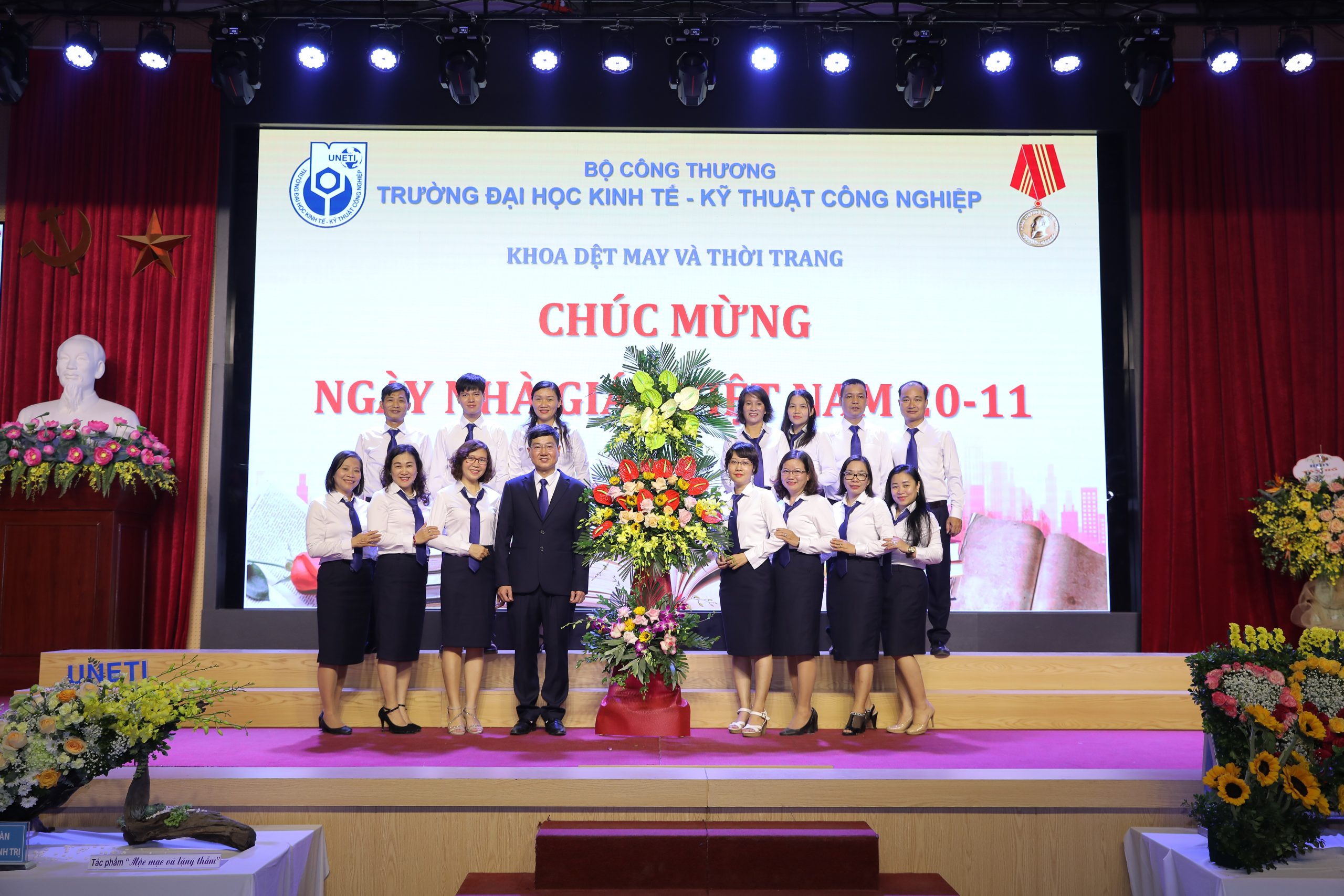
The collective of lecturers and staff of the Faculty of Textile and Fashion has been awarded numerous Certificates of Merit by the Prime Minister of Vietnam, the Ministry of Industry and Trade, and Nam Dinh Province, among others.
Titles and awards achieved by students of the Faculty in recent years:
| No. | Name | Class | Year | Achievements |
| 1 | Nguyễn Thị Mai Hiên | CĐ May 16 | 2010
2011 |
First Prize awarded by the Ministry of Industry and Trade First Prize at the National Level First Prize at the Southeast Asia Level; participation in and receipt of certification from competitions held in the United Kingdom |
| 2 | Dương Công Duy | LT May8 | 2012 | First Prize awarded by the Ministry of Industry and Trade; Third Prize at the National Level |
| 3 | Mai Thi Hoa | CĐ May18 | Second Prize awarded by the Ministry of Industry and Trade | |
| 4 | Phạm Thị Trang | CĐ May20 | 2014 | First Prize awarded by the Ministry of Industry and Trade; National Consolation Prize |
| 5 | Phạm Thị Giang | ĐH May4 | Consolation Prize awarded by the Ministry of Industry and Trade | |
| 6 | Đỗ Văn Trung | CĐ May22 | 2016 | First Prize awarded by the Ministry of Industry and Trade; Third Prize at the National level |
| 7 | Nguyễn Thị Hồng Vân | ĐH May7 | Third Prize awarded by the Ministry of Industry and Trade. | |
| 8 | Nguyễn Thị Hoa | CĐ May24 | 2018 | First Prize awarded by the Ministry of Industry and Trade, and a Consolation Prize at the national level. |
| 9 | Vũ Thị Nhung | CĐ May24 | Consolation Prize awarded by the Ministry of Industry and Trade. |
3. Organizational Structure:
– Unit Leadership:
| No. | Name | Position | Tel | |
| 1 | ThS. Đào Anh Tuấn | Deputy Dean – Acting Head of the Faculty | datuan@en.uneti.edu.vn | 0912224710 |
| 2 | TS. Nguyễn Quốc Toản | Deputy Dean | nqtoan@en.uneti.edu.vn | 0979833777 |
Departments
| No. | Name | Position | Departments | Tel |
| 1 | Th.S Đào Anh Tuấn | Head | Textile Technology Division | 0912224710 |
| 2 | Th.S Nguyễn Thị Thùy | Deputy Head | Textile Technology Division | 0988750921 |
| 3 | TS Nguyễn Quốc Toản | Head | Garment Technology Division | 0979833777 |
| 4 | Th.S Đặng Thị Kim Hoa | Deputy Head | Garment Technology Division | 0912464446 |
| 5 | Th.S Đỗ Thị Tuyết Lan | Deputy Head | Garment Technology Division | 0855886682 |
| 6 | Th.S Phương Công Huấn | Deputy Head | Fashion Design Division | 0373796222 |
Party Cell, Mass Organizations:
| No. | Name | Position | Tel |
| 1 | T.S Nguyễn Quốc Toản | Secretary of the Party Cell | 0979833777 |
| 2 | Th.S Đào Anh Tuấn | Deputy Secretary of the Party Cell | 0912224710 |
| 3 | Th.S Lê Xuân Thắng | Head of the Grassroots Trade Union (Nam Định Campus) | 0916073045 |
| 4 | Th.S Trần Thị Thu Hà | Head of the Grassroots Trade Union (Hà Nội Campus) | 0915118257 |
| 5 | Th.S Trần Nguyên Lân | Secretary of the Faculty Youth Union | 0905307788 |
Faculty staff and lecturers
1. Th.S Đào Anh Tuấn
2. TS Nguyễn Quốc Toản
3. Th.S Đỗ Thị Tuyết Lan
4. TS.GVC Nguyễn Thị Thảo
5. Th.S Đặng Thị Kim Hoa
6. Th.S Phương Công Huấn
7. Th.S Vũ Dương Quang
8. Th.S Nguyễn Thị Thùy
9. Th.S Lê Xuân Thắng
10. Th.S Nguyễn Thị Thu Lan
11. Th.S Bùi Thanh Hương
12. ThS. Nguyễn Thị Hạnh
13. Th.S Lê Thị Tâm Thanh
14. Th.S Trần Thị Thu Hà
15. Th.S Đỗ Thi Lan
16. Th.S Nguyễn Gia Phong
17. Th.S Đặng Thị Lý
18. Th.S Bùi Thị Thu Hiền
19. Th.S Nguyễn Thị Lan Anh
20. Th.S Nguyễn Thanh Nam
21. Th.S Bùi Quang Lập
22. Th.S Trần Nguyên Lân
23. Th.S Trần Thanh Hải
24. Th.S Nguyễn Thu Thủy
25. Th.S Quách Thùy Dương
26. Th.S Cao Minh Tiến
27. Th.S Nguyễn Thị Hòa
28. Th.S Trần Thụy Liên
29. Th.S Nguyễn Thanh Hương
30. Th.S Đào Thị Tình
31. CN. Phùng An Như
4. Functions and Duties
Functions:
The Faculty of Textile and Fashion is a unit directly under the University, with the function of advising and assisting the Rector in implementing the following tasks: managing and developing the faculty staff in carrying out assigned teaching duties; professional management of training programs in Textile and Garment Technology and Textile and Garment Materials Technology; organizing and managing scientific and technological activities; managing and organizing the development of curricula, syllabi, textbooks, learning materials, question banks, etc. for teaching and learning purposes; managing, proposing, and effectively utilizing facilities and equipment assigned by the University; establishing linkages and cooperation with enterprises and alumni in training, scientific research, and recruitment.
Duties:
-
Managing and developing the faculty staff.
-
Proposing the development and adjustment of the Faculty’s organizational structure and human resources.
-
Organizing scientific and technological activities; proactively exploiting international cooperation projects; coordinating with scientific and technological organizations, production and business entities to link training with scientific research, production, business, and social life.
-
Organizing the compilation of teaching materials and textbooks: regularly updating domestic and international resources to develop textbooks, lectures, and learning materials; researching and improving teaching and learning methods to enhance training quality and meet societal needs.
-
Managing and effectively utilizing facilities and equipment assigned by the University; proposing plans for procurement and maintenance of equipment serving teaching, learning, practice, and internships.
-
Coordinating with enterprises, functional departments, and alumni to conduct surveys on graduates’ employment and employers’ recruitment needs in order to adjust and develop appropriate program learning outcomes and enrollment plans; coordinating with internal and external units to organize scientific seminars, professional activities, and student internships, field trips, and experiential learning to link teaching with practice, enabling learners to effectively apply knowledge and further develop to meet societal needs.
5. Scale and Operational Capacity
– Training: Actively implementing self-assessment of training programs, progressing toward external evaluation; developing program learning outcomes to update and meet societal needs and international integration trends; strengthening the linkage between theory and practice to meet program learning outcomes and labor market demands.
– Scientific Research: Participating in ministerial-level and departmental-level projects under the Ministry of Labour, Invalids and Social Affairs; key projects; and university-level projects. Leading and participating in collaborative activities in research and technology transfer with domestic, regional, and international organizations.
– Training Cooperation: The Faculty of Textile and Fashion has established and continues to develop cooperative relationships with training institutions and enterprises to enhance training quality and meet employers’ requirements.
6. Development Orientation
– Continuously improving the quality and increasing the number of faculty members holding doctoral degrees.
– Developing recruitment, training, and professional development plans to enhance faculty quality and qualifications in all professional and pedagogical aspects, meeting program learning outcomes.
– Increasing participation in and leadership of scientific research projects at national and ministerial levels, as well as projects under the General Department of Vocational Education and Training, university-level and faculty-level projects in science and technology.
– Enhancing both the quantity and quality of student scientific research projects.
– Strengthening the organization of specialized scientific and technological seminars across the Faculty’s disciplines to improve training quality and innovate teaching content and methods for maximum effectiveness.
– Achieving outstanding collective and individual accomplishments, particularly increasing both the number and quality of high-achieving students.
– Successfully fulfilling teaching tasks; regularly updating and timely innovating objectives, curricula, and teaching–learning content; investing in modern equipment to meet societal needs.
– Further improving teaching and learning effectiveness as well as students’ practical skills.
– Progressing toward postgraduate (graduate-level) education.
7. Contact Information
-
Hanoi Campus: Room 608, HA10 Building, No. 218 Linh Nam, Hoang Mai District, Hanoi
-
Nam Dinh Campus: Room 802, NA2 Building, No. 353 Tran Hung Dao, Nam Dinh Ward, Ninh Binh Province
-
Website: https://en.uneti.edu.vn/khoa-det-may-va-thoi-trang/
-
Email: khoadetmay@en.uneti.edu.vn